

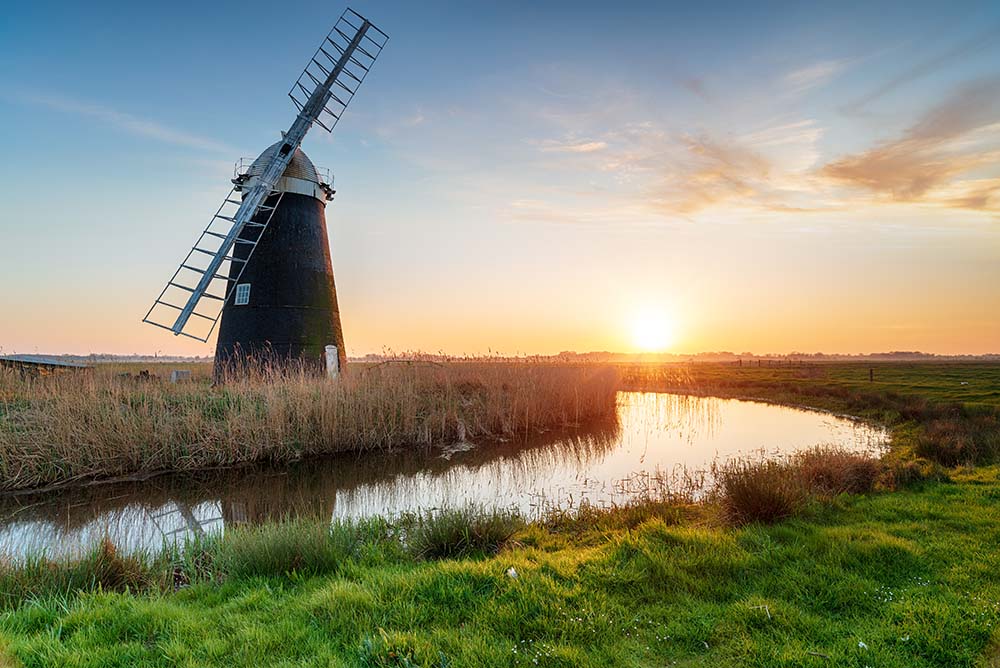
It’s the fifth largest county in England and its county town is the most easterly city in the UK. It’s a generally flat landscape – the highest point is barely 338 ft above sea level. And if your caravanning companions are forever complaining about wet weekends peering out onto the great outdoors, you’ll be pleased to know that the county is the driest in the whole of the UK.
If you’ve never taken your caravan to Norfolk before, you might be pleasantly surprised to discover that there’s a lot more to the place than initially meets the eye.
1. The Broads
Even if you’ve never visited the place, Norfolk and the Broads are two words forever intertwined.
It’s a fair enough point since Norfolk boasts no fewer than 41 separate broads – a manmade phenomenon created by the flooding of old peat workings. The most expansive of all the broads is Hickling – which covers more than 348 acres (141 hectares) of water – and the second biggest is called Barton.
Messing about in small boats during the day and retiring to your comfortable touring caravan for a good night’s sleep is many people’s idea of heaven.
2. Norfolk coast
The broads might be the best-known feature, but Norfolk offers a whole lot more under its famous wide-open skies.
And the sheer expanse of those huge skies is perhaps nowhere better appreciated than along its 100-mile-long coastline. This is a protected landscape of more than 175 square miles (450 sq. km.) of the agricultural and coastal land that make up the Norfolk Coast Area of Outstanding Natural Beauty that stretches from the sand dunes at Winterton in the east and the Wash to the west.
3. Norwich
Norwich may be one of those English cities too often overlooked by visitors and locals alike – yet it boasts a rich history and a flourishing contemporary scene of independent shops, lively bars and restaurants, and a vibrant cultural setting for its music and arts.
History buffs will marvel at a place that is the most complete example of a medieval city in the whole of the UK while today’s writers and artists continue to celebrate a heritage of more than 900 years as a City of Literature designated by UNESCO.
4. Thetford Forest
The British Isles are covered in acres of forest – and that might help to explain our natural fascination with the peace and tranquillity of wooded landscapes.
The trails and picnic areas throughout the vast Thetford Forest in the centre of the county offer just that opportunity to soak up the wonder of the British countryside in the biggest lowland forest in the country.
Covering some 80 square miles (207 sq. km.) Thetford Forest was created as recently as 1922 and today offers well-established broadleaved and pine trees interspersed with open heathland.
5. Seaside resorts
While some might be attracted to the wide open skies of Norfolk’s undeveloped coastline, others are drawn to the delights of a typically English seaside resort.
Great Yarmouth and Cromer both fit the bill – with an almost old-world charm of pleasure beaches, golden strands, and wrought-iron piers that attracted their fair share of Edwardian and Victorian tourists and continue to make for a great family day out.
6. Days out with the kids
Activity days out with the kids might help tire them out so you can soak a little relaxation later – and Norfolk has plenty of locations to choose from.
Try the Hilltop Outdoor Centre near Sheringham, for instance, and watch with bated breath as the little ones take to the climbing wall and assault course, power fan, super swing, and zip wires. If the energy is flagging but curiosity is still high why not take them to one of the more unusual – not to mention creepy-crawly – zoos in the UK? At Bugz UK near Lenwade, you can view – and the bravest among you can even handle – up to 200 different species of invertebrates housed in three large tropical houses.
If you’ve never visited Norfolk before, you’re bound to discover that there’s likely to be something for everyone in this part of East Anglia.