
Fire safety tips in your ‘van
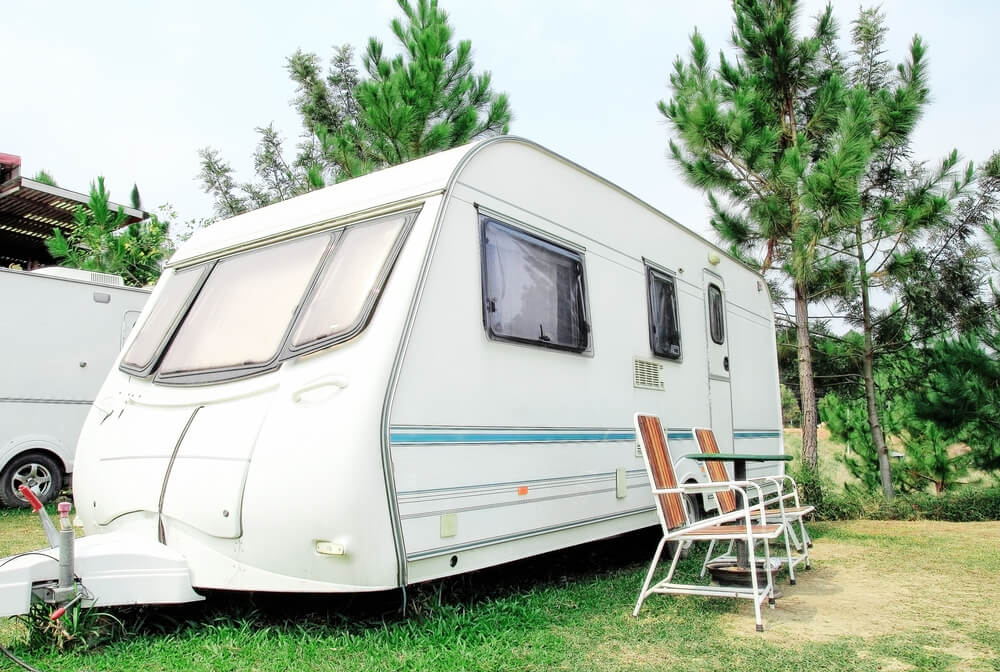
Fires are dangerous anywhere and caravans are no exception.
Prevention
It’s always better to stop a fire happening than to try and deal with its consequences. Many basic fire prevention techniques are common-sense but don’t take them for granted.
Familiarise yourself with them or perhaps just refresh your memory. Either way:
- don’t smoke in caravans;
- avoid heating large quantities of cooking oil, notably chip pans. Cooking oil fires are a common cause of fire in homes but they can be easily avoided by using one of the modern fully enclosed and low-fat content fryers;
- use heaters for heating, not for drying clothes;
- if your caravan is an older model, make sure you replace potentially flammable foam coverings with modern fire-resistant varieties;
- whatever the attractive call of the outside world, don’t leave your caravan unattended while food is cooking on the stove;
- unless you are a qualified electrician, don’t try to enhance the caravan’s electrical systems;
- make sure there are at least six metres between you and other adjacent caravans. This stops fires spreading;
- even if the weather isn’t cooperating, never be tempted to bring the barbecue into the caravan. The same holds true for portable camping gas stoves;
- pay special attention to young children and sources of flame. In the modern world, many might never have seen a lighter or a box of matches before they go on a caravan holiday, and you won’t want them experimenting inside while you are outside.
In addition, always inspect your electrical appliances before use, especially if they’ve been in storage over winter. Cables can become frayed or perish with age and temperature changes. Faulty wiring or overloaded sockets are a common cause of caravan fires, so avoid daisy-chaining multiple appliances into one outlet.
Also check your gas lines and appliances regularly, ideally before every trip. A simple leak detection spray or soapy water can help you identify any leaks around fittings and regulators. If you detect a leak or smell gas, turn off the supply immediately and get it checked by a qualified Gas Safe registered engineer.
Precautions
There are some steps you should take just in case:
- fit optical smoke detectors. They should detect a fire in its very earliest stages and give you a chance to deal with it before it becomes a major threat;
- have a fire extinguisher or extinguishers fitted somewhere away from the stove. There are different types to be used in different situations, so you should select those that are appropriate based on professional advice;
- make sure you also fit a carbon monoxide (CO) detector. CO can be lethal. Make absolutely sure also that all ventilation in the caravan is unobstructed and working well;
- no fire extinguisher is particularly ideal for cooking fat fires. So, you should also have an approved fire blanket
- familiarise yourself thoroughly with how extinguishers work. In the event of a fire, you won’t have time to stand around reading and trying to learn all this;
What to do if the worst happens
If you need to react to the fire:
- your absolute top priority should be to get everybody out of the caravan immediately. It doesn’t matter whether it is raining outside or the fire appears minor, get everybody out. Do not start trying to collect valuables or other personal belongings;
- attempt to deal with the fire with your own appliances if it is minor and you believe it is safe to do so. Above all, keep your access to the exit entirely clear. Do not let the fire come between you and that exit;
- if a fire appears severe or you doubt your ability to deal with it, call immediately for professional help through the emergency services;
- be certain you are using the correct type of extinguisher for the type of fire;
- do not try to deal with fires originating from bottled gas supplies or those which are directly adjacent to them. Retreat a long way away and call for Fire Brigade assistance. Where gas supplies are involved, remember to notify your neighbouring caravans so they can evacuate a further distance away too.
Don’t forget to keep fire exits clear at all times. Avoid stacking furniture or equipment in front of doorways or windows that could serve as emergency exits. Remember, caravans are compact spaces and obstacles can quickly create dangerous bottlenecks during a fire.
If safe to do so, turn off gas and electricity supplies before evacuating. However, only do this if you can reach the controls without going through flames or smoke. Your safety and that of your family must come first.
It’s also worth practising an evacuation plan with your family or travel companions, particularly if children are involved. Agree on what each person should do and where you’ll meet outside the caravan in the event of a fire.
Remember – plan in advance
As mentioned above, when a fire has broken out is not the time to start trying to learn for the first time about how to deal with it.
For the protection of yourself, your family and other caravanners around you, make sure you find 30 minutes or so to familiarise yourself with basic fire prevention and fire-fighting techniques using appropriate safety equipment.
Rectory Farm Site Review
Caravan & Motorhome Club CL – 5 pitches site, members only
LE15 9TJ
Date of Visit: July 2025
Overall View
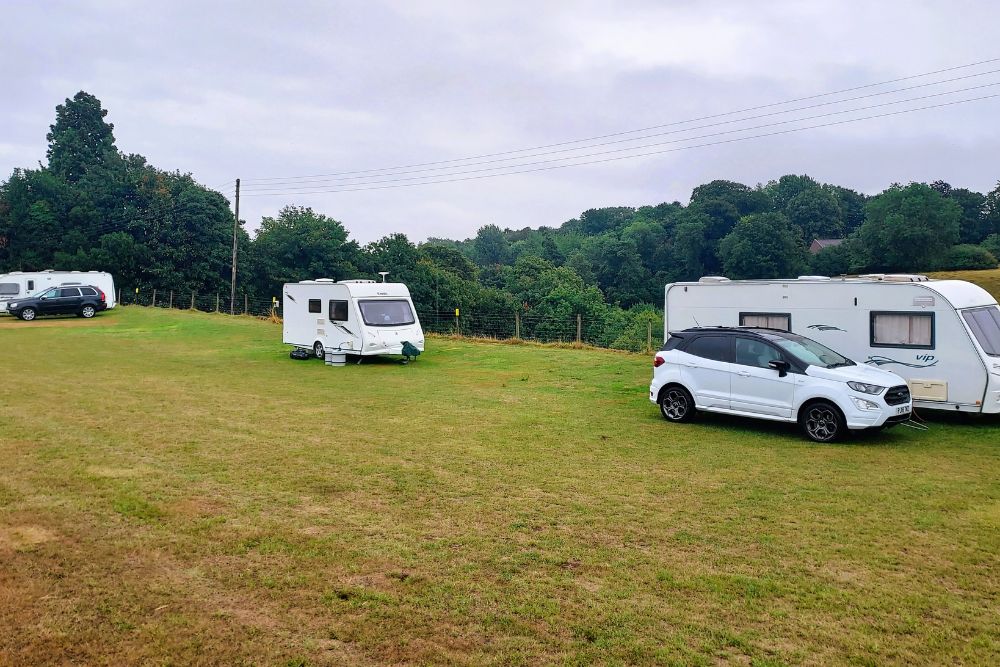
This is a small, basic, but fully functional CL members only site on the outskirts of Uppingham in Rutland. The owners are very welcoming and only too willing to help if you require it. They are able to give you all the local information as well. It is situated to the side of the working farm, although this is not intrusive in any way. Dogs are allowed on site, on leads at all times. Access is relatively straightforward, please see arrival video HERE.
Facilities
The CL has 16amp EHU to each pitch. There is the usual clean water tap, grey water disposal and chemical disposal point at the entrance to the site. There is also a recycling bin and rubbish disposal here.
None of the mobile network providers offered 5G but we had no problems streaming TV using EE and the roof mounted puck. Inside the ‘van the signal was poorer, as it was for Three. The coverage checkers suggest 4G indoors and outdoors for O2 but only outdoors for Vodafone. There was no site WiFi.
Both radio and TV reception was excellent – with TV you could choose from three regions for local content.
There are bus stops close to the entrance to the site – these go into Uppingham and Corby in the opposite direction.
https://www.rutland.gov.uk/rutland-buses/uppingham-buses
Review of Site Pitch
The site/field is predominantly level and lain to grass. There is a certain amount of freedom as to which way you pitch your vehicle, so as to make the most of the views of the valley to the side. We opted to pitch sideways so that the canopy looked over the valley and we could sit out and admire the view. The site is very well kept.
Around and about
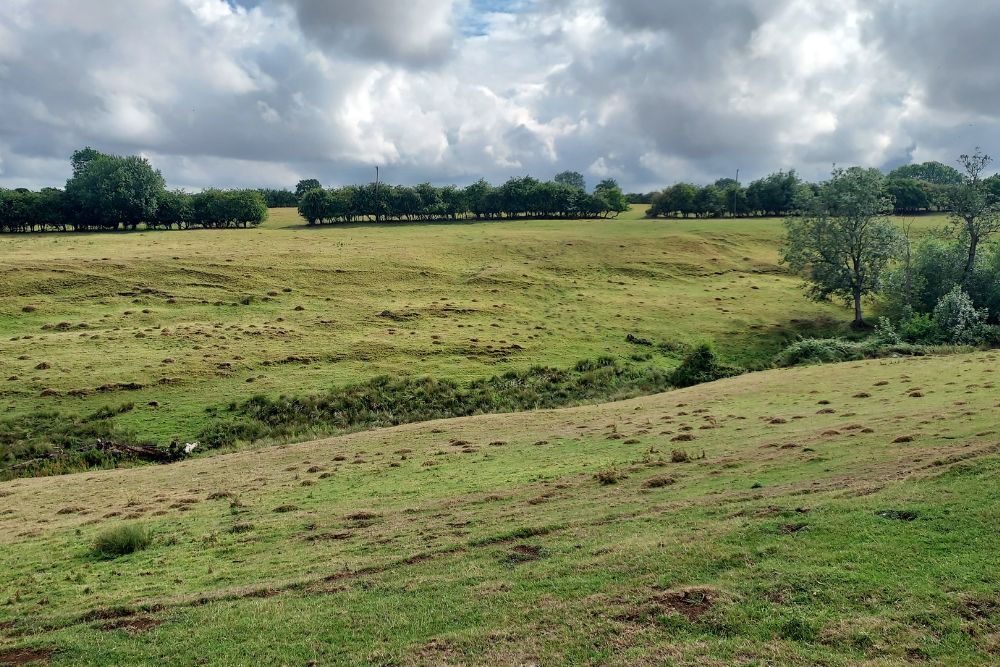
Rutland claims its famous badge by being the smallest county in England, although it packs a lot of very pleasant and attractive places, activities within its confines. A useful starting point is https://discover-rutland.co.uk/
The nearest village is Uppingham – a five minute drive from the site – there are several car parks dotted around, blue badges do not have to pay. There is a Co-Op here and this is the nearest convenience store.
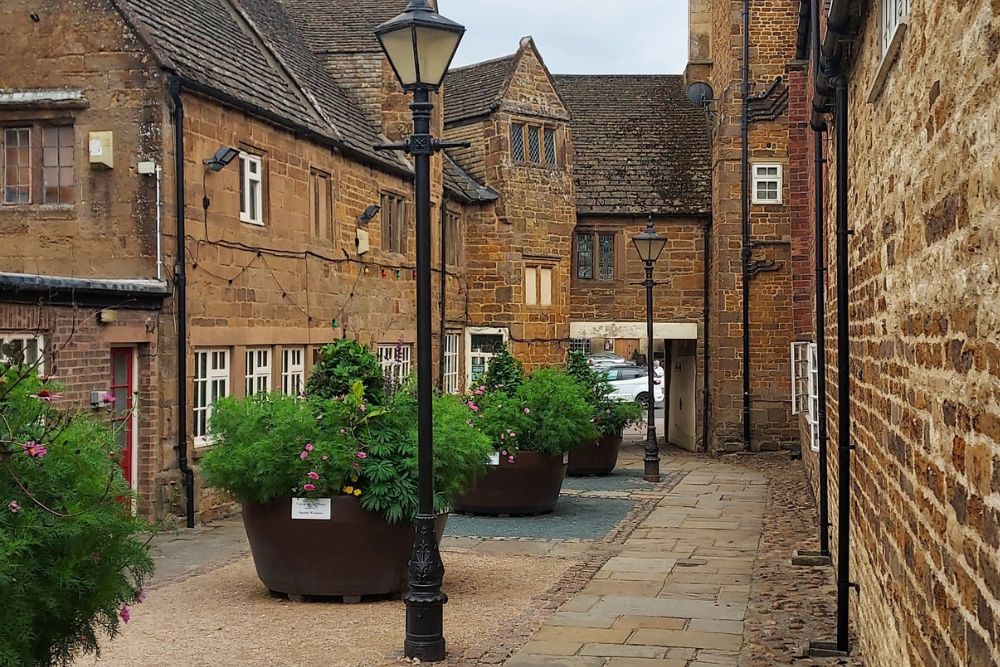
There is also an excellent Fish and Chip shop called Silvers Fish Bar – ordering is available on line for subsequent collection. They do not deliver.
https://silverfishbar.co.uk/ There are a number of Chinese and Indian Takeaways in the town but we did not try these out on this visit.
Fuel is available at the garage on the main crossroads in the village – it is the only one for some distance, so prices are not necessarily that competitive. Corby, a half hour drive away has the larger supermarkets with fuel available.
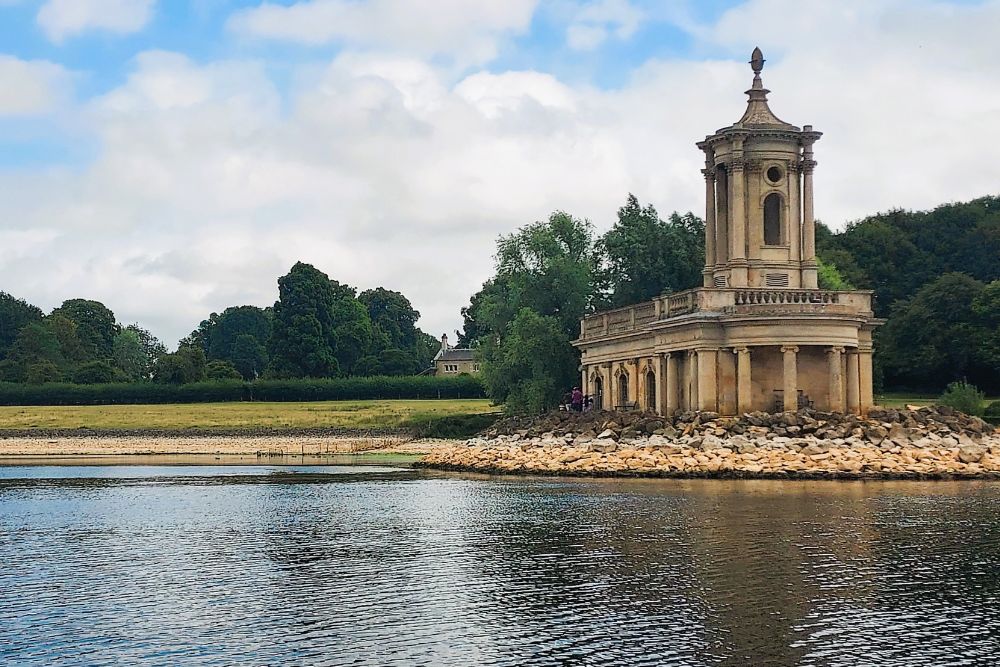
One of the biggest attractions, outside of the very pretty villages etc is Rutland Water – a large reservoir, built in the 1970s to meet the anticipated needs of a growing East Midlands population. At first it was not really called on too much, but as temperatures have heated up in summers, it is now fully utilised. You can sail on here, paddleboarding, though not swimming. There is a large Aquapark at the North Shore which is where swimming and having a go on the assault course in the water is allowed. Great for children of all ages! https://aquaparkgroup.co.uk
It is also possible to take a boat trip around the reservoir, which is essentially horseshoe in shape, with a useful commentary and enabling you to see the dam. There is tea and coffee plus biscuits available, plus a toilet on board. Cream scones are available but must be ordered in advance. There is access for wheelchairs, pre-bookable in advance. Dogs are allowed as well. https://rutlandwatercruises.com/
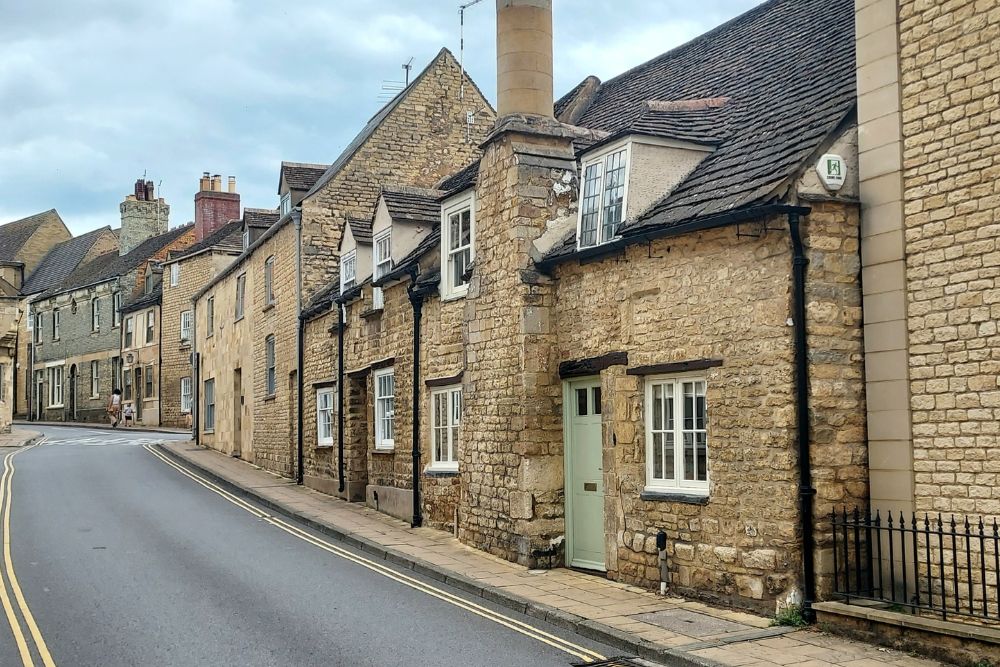
Slightly larger villages/small towns are all within half an hour’s drive, namely Oakham and Stamford, the latter just being over the border into Lincolnshire. Both have railways stations. There are a larger range of shops and Stamford is particularly noteworthy in having a pedestrianised High Street and many independent shops. Its proximity to the A1 – formerly a Roman road, is shown by some of the architecture. https://www.visitlincolnshire.com/destinations/stamford/
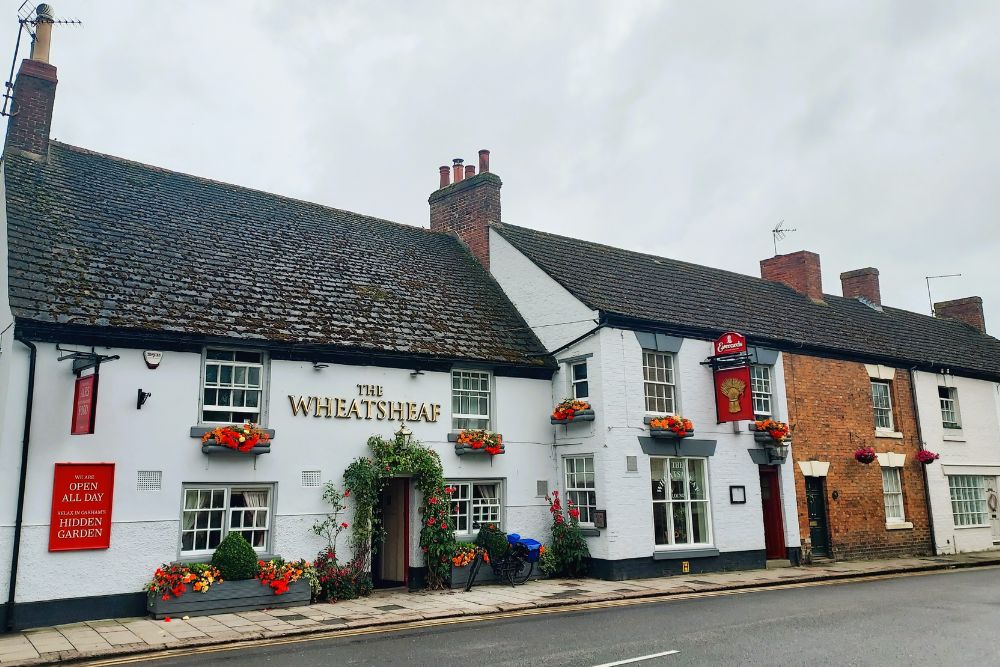
For a superb Sunday lunch, a trip to Oakham and the Wheatsheaf is highly recommended. Car parking is close by plus on-street blue badge bays within a few metres. Very dog friendly and accessible, plus a good range of real ales on hand pumps which are changed regularly. Booking ahead, especially on a Sunday is advisable. It is possible to opt for a regular portion or a smaller version, useful for those with smaller appetites.
A visit to this area should include a trip to the nearby Market Town of Uppingham. https://discover-rutland.co.uk/uppingham/ It has all the facilities you might need including a Co-Op supermarket. It is possible to catch a bus to Leicester from outside the Co-Op. There is a very attractive little high street with plenty of independent shops plus a good smattering of charity shops. A few pubs and cafes complete the High Street. Overlooking the market square, (usually held on Friday) is the Post Office and a pub plus a lovely café serving delicious cream teas and hot pots of tea. There is plentiful seating outside and dogs are allowed there. Car parking, except Friday, is here. There are also accessible toilets here too, RADAR key required. Finally, there is a good old fashioned hardware store – and given the stain glass window inserts, it has been a hardware shop for a good many years. The owner is very helpful and it is spread over 3 floors. There is also a guided Heritage Trail round the town by means of QR codes – there is a lot of history here. https://discover-rutland.co.uk/listing/uppingham-heritage-trail/
Summary
A very pleasant site in a convenient location. It has all that you need if you are happy to use your own onboard facilities. The owners are very helpful and friendly. A very green and attractive part of the country. It is definitely a site we would return to in the future.
Appuldurcombe Gardens Holiday Park Site Review
Date of Visit: July 2025
Overall View
Appuldurcombe Gardens is a privately owned, family friendly site on the Isle of Wight in the village of Wroxall, a few miles north of Ventnor to the south of the Island. Access is relatively straightforward, please see arrival video HERE. It is a participant in the Red Funnel combined discounted ferry and stay ticket scheme which includes your car, caravan, two adults plus a number of nights stay in a choice of caravan sites in the fare. Various restrictions apply, as usual, regarding height etc. It should also be noted that WightLink and the Camping and Caravan Club offer similar discounted schemes.
The site is a mixture of all types of pitches including grass, hardstanding, all with electric hookup and progresses up to a fully serviced pitch with water and grey waste drainage. There are all types of caravans, motorhomes and camping outfits all intermingled across the site.
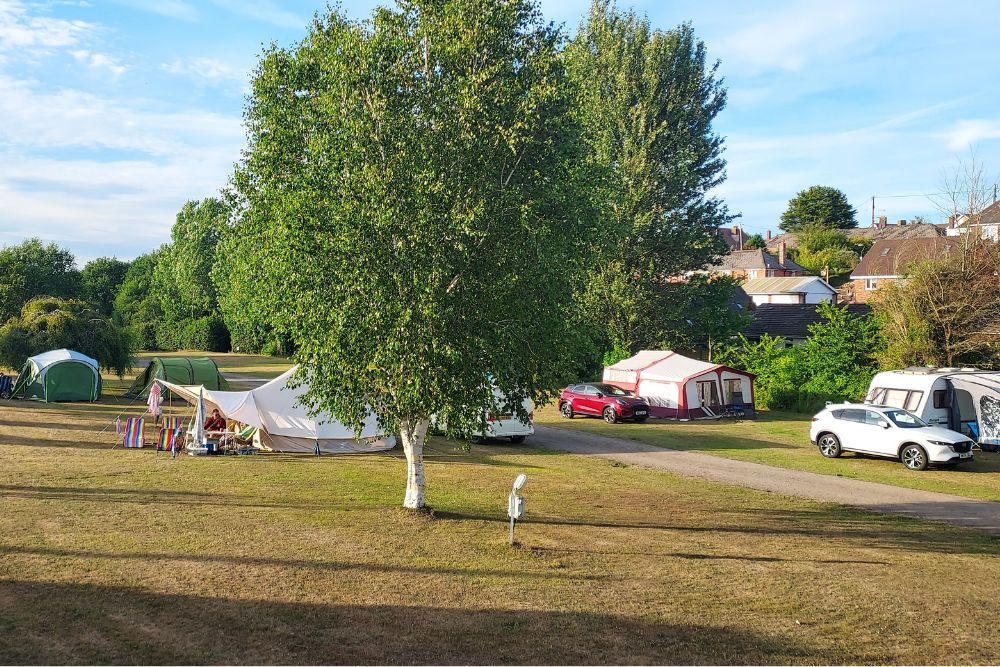
Facilities
There are two toilet blocks with showers, toilets and wash basins. There is one accessible toilet in the newer block which is situated in the centre of the site.
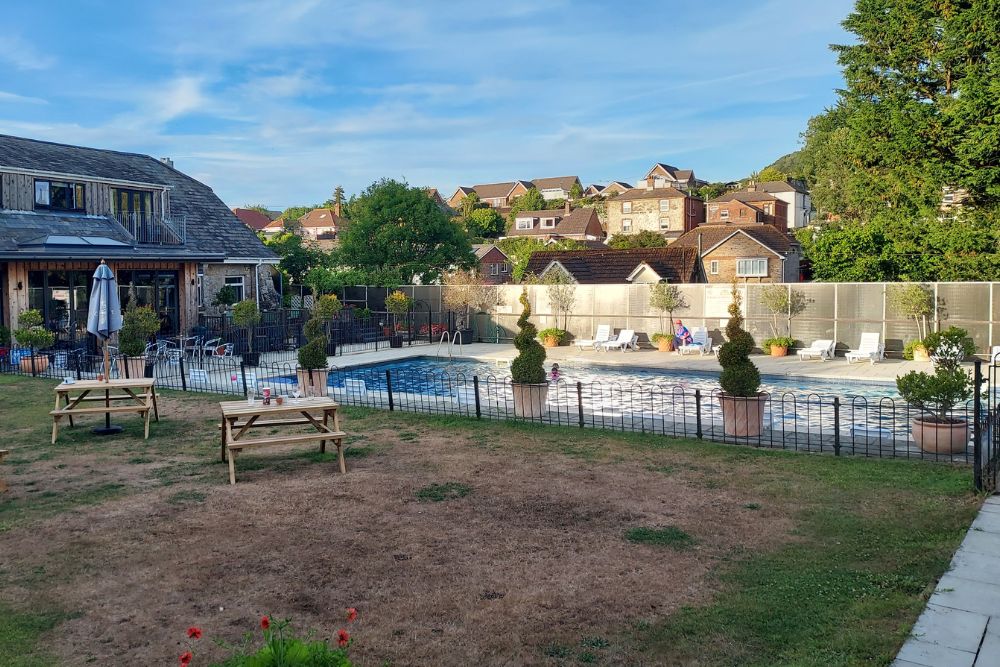
The site also has a swimming pool by which is situated the bar, café/restaurant and a picnic area on grass.
The site is dog friendly and they are allowed everywhere apart from the immediate, fenced off area around the swimming pool. There is, however, plenty of seating just outside this where you can sit with your dogs and still watch the swimming.
There is a laundry on site with irons and ironing boards available plus a large handwash Belfast style sink for your use. Normal charges apply for the washing machine, dryers and ironing boards.
Reception is situated at the entrance to the caravan and camping part of the site. The other toilet block is situated at the end of this plus one of the two CDPs. A freezer is available, foc, to enable you to freeze ice blocks if you so wish.
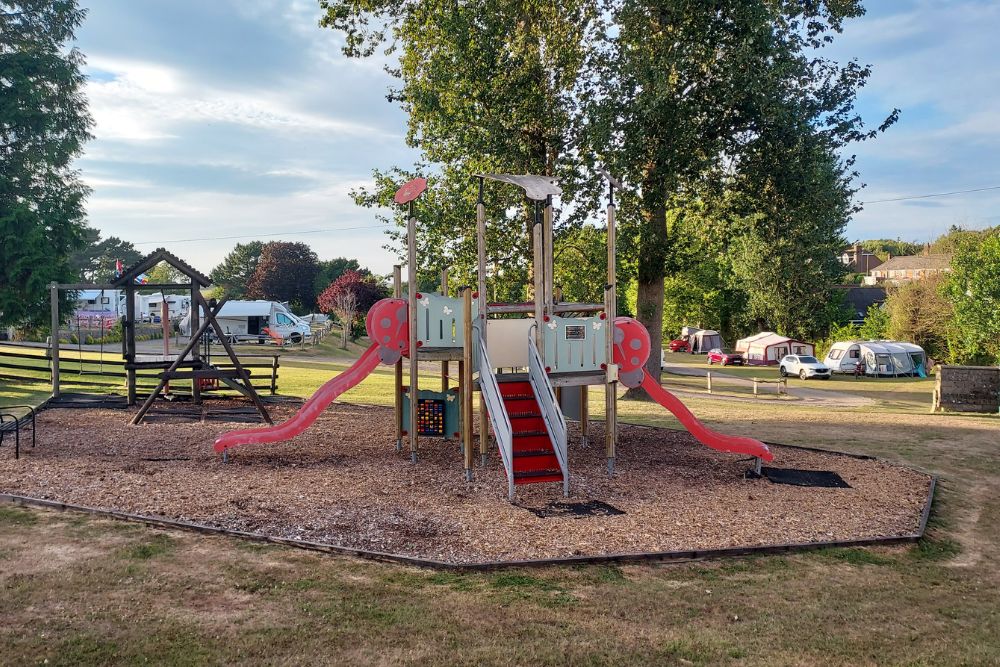
There is a small children’s playground at this point too. Seating is available should you require it.
Inside the old walled garden area are the static caravans – this is where the pool and laundry are situated.
Review of Site Pitch
Our pitch was on the outer edge of the site, laid to grass with EHU. We had plenty of space to spread out as it was effectively at the end of a line of vehicles on the corner. We could have opted for a fully serviced pitch but were advised that these were mainly in full sun all day. Given the recent weather and with two elderly dogs on board, we felt that this was not the best idea. Our water tap is literally two minutes’ walk away around the front of the barn on the corner of our pitch, so although it could be seen as an inconvenience, we felt that this was a price worth paying to ensure a nice shady spot and privacy of hedging to the rear.
The pitch was relatively level and the grass well-kept in our area. The delineation of the pitches was somewhat haphazard in places and we were concerned that the usual safety guideline of 6m, minimum, between outfits was not being observed in a fair few cases. The roadways around the site are laid to gravel.
Site WiFi was offered but didn’t reach our pitch, though it was available in the bar area as was BT/EE WiFi – free if you are a customer of either.
Mobile wise, EE was the best, offering a strong 5G signal. 3 offered 5G too but was much weaker. The coverage checkers for both Vodafone and O2 report a good 4G signal.
Both TV and radio reception was good.
Around and about
The Isle of Wight is essentially a one-stop tourist destination all over the island. It may be only 13 x 9 miles approximately but it certainly packs a lot in for its small size. Beware, though, there are a few areas which have been over-developed to the point of being rather unpleasant and disappointing. They are, however, in the minority.
As always, I would suggest that a useful starting point is, www.visitisleofwight.co.uk This will enable you to plan out a series of visits/activities you may want to look at further. Our stay was 10 nights, which we felt was a reasonable time to visit the main attractions on our list.
The south coast of the island from Needles in the west to Ventnor in the south is very peaceful, dramatic scenery and beautiful beaches – some with toilets, ice cream trucks. Many do not have any facilities, so if you wish to spend a day in the sea here, you will need to take everything with you.
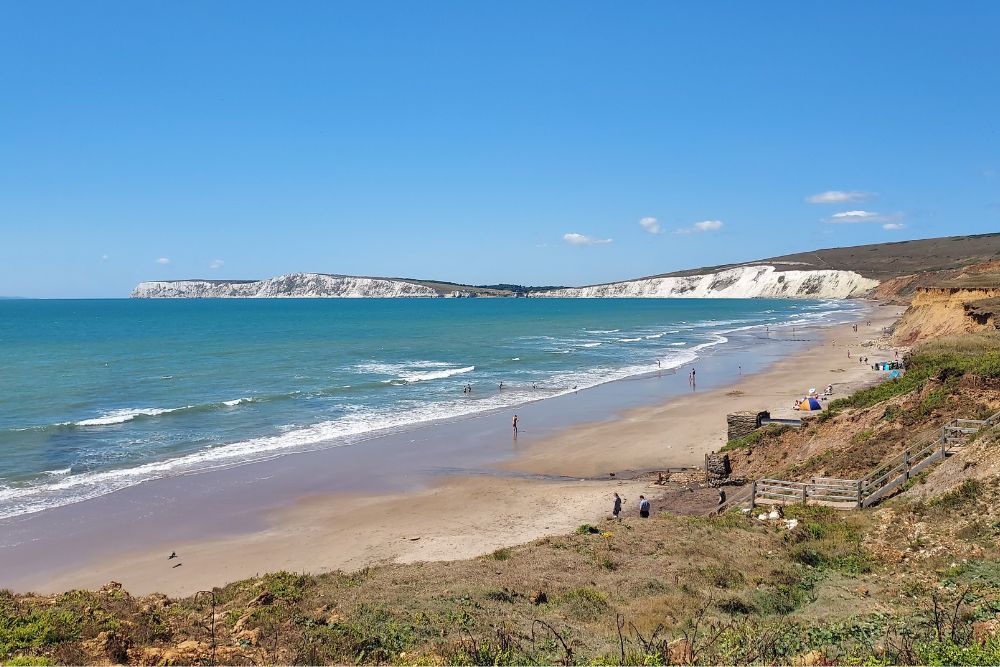
Ventnor, from this site is one of the closest towns and has the usual range of shops including a Tesco Express. It is a very hilly town but there is limited parking down on the front, including accessible parking, full set of toilets and a number of cafes and bars. Toni’s Tea Room on the front is very pleasant serving great coffees and toasted teacakes. It is, like many places except perhaps beaches, that welcome dogs across the island. There is also a paddling pool attached to a bar/restaurant/café at one end of the beach.
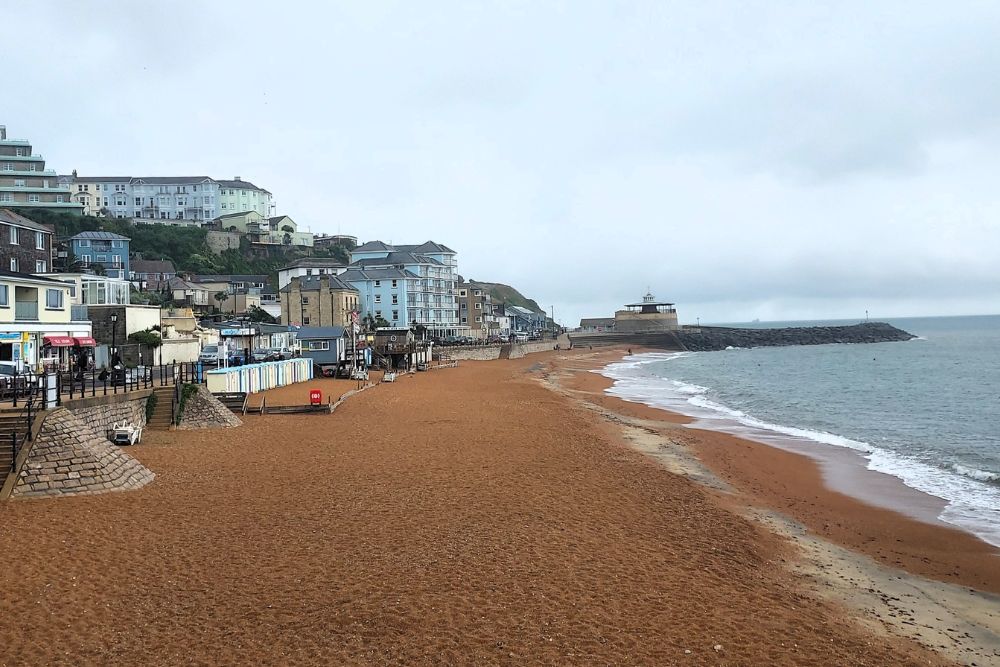
The nearest supermarket – which also offers fuel – was Morrisons, on the outskirts of Sandown, about a 10 minute drive away.
Ventnor Botanical Gardens are worth a visit but be aware that it is quite hilly in parts.
Buses are plentiful all across the island. www.islandbuses.info There are two stops a short 5 minute walk from the site entrance and run roughly every 30 minutes towards Newport in one direction. In the opposite direction they run to Ventnor then up to Shanklin, Sandown and then inland up to Ryde. Change in Newport to go to Cowes in the North and destinations to the West of the island.
Newport being the main town on the island hosts most of the larger supermarkets, Morrisons, Aldi, Sainsburys plus usual suspects of a typical out of town retail park. There are a number of independent fuel stations across the island but supermarket prices will necessitate a trip to one of the towns, if offered.
If you happen to visit the IOW at the appropriate times of the summer, you will be able to visit either the Royal Isle of Wight County Show or the world famous Cowes Regatta week.
If you travel from Southampton to the Isle of Wight, your entrance point will be East Cowes. Obviously on arrival you will be keen to get to your chosen site and set up. It would be an omission to not return and take in the amazing views and scenery that is available in both Cowes and East Cowes. This is where the Royal Yachting Society Cowes Regatta is held each year, please see link above. We visited on a gloriously sunny and warm day. There is some parking down on the front but it is payable except Blue Badge holders and only for an hour at a time. There are some nice bars and cafes on the front, along with some very expensive shops. The apartments, with their balconies, would not look out of place on a top cruise liner.
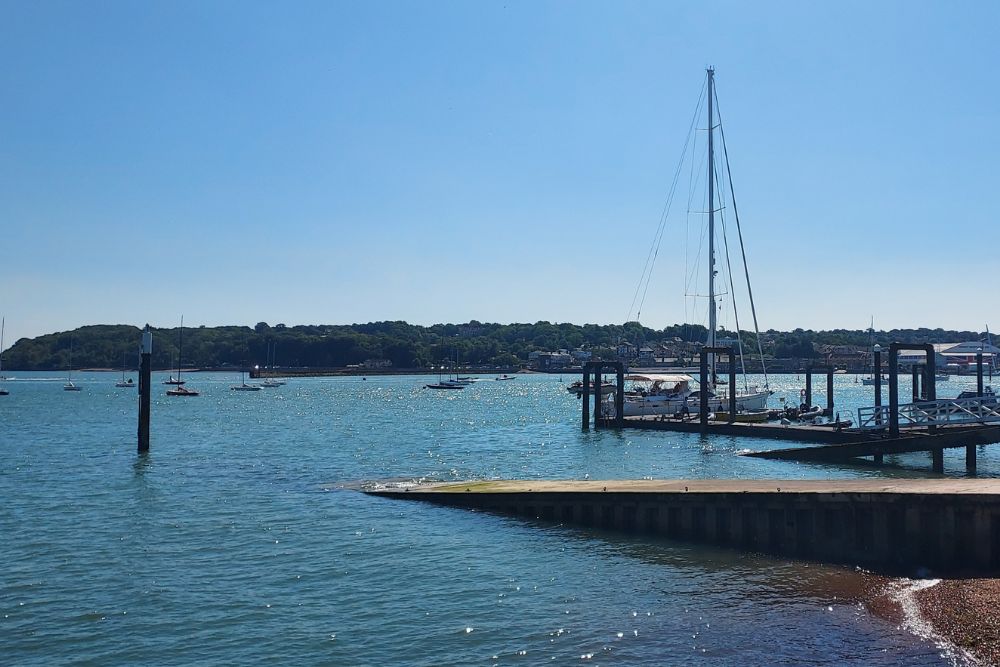
There is a pleasant, pedestrian only high street with a few independent shops and a sprinkling of ice cream and cafes too.
Following your visit to Cowes, it is highly recommended that you take the chain link Ferry across the river mouth to East Cowes. You can take your car, bike or go by foot. What is definitely not recommended is to take a caravan or trailer. Any low slung sports cars would be a great risk of grounding too. It takes a mere 5 minutes from start to finish but is a very unique experience. In East Cowes on the front there is a lovely children’s paddling pool, playground and seating – dogs are not allowed. The views are tremendous across the Solent and seeing all the shipping.
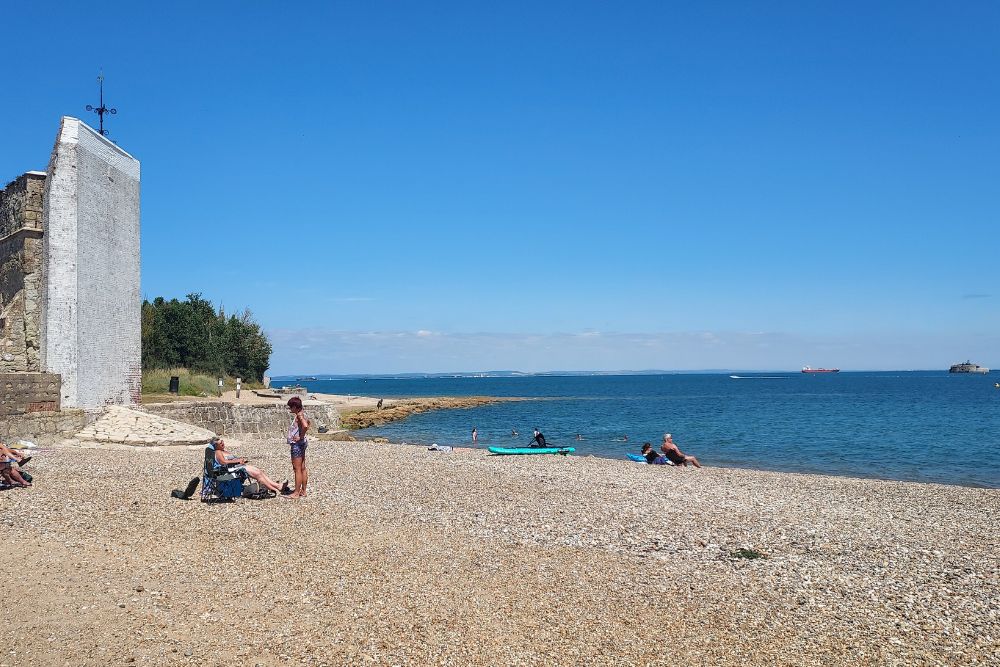
St Helens has a beautiful beach with very limited parking to the rear. There are the remains of a church dedicated to mariners. Swimming is very popular here; there are toilets and a café too.
Summary
The Island is a very beautiful destination, relatively easy to get too, if an additional cost of course. There are plenty of attractions to choose from and you can easily have a fun-packed and busy 10 night stay.
This site is very pleasant and offers a very good range of services. Nowhere is that far from each other, so staying at a site in the southern part of the island was not an issue at all. We will be returning in the future.
Choosing touring caravan insurance
What do you need to consider when your choose your touring caravan insurance? Let’s take a closer look.
First of all, there is no legal obligation for caravan insurance as such. But you need motor insurance, of course, for the towing vehicle and that typically offers at least third-party cover for the trailer (but check the precise wording of your car insurance policy). This, typically, does not cover the tourer itself – meaning if something happens to it, you could face the cost of repair or replacement out of your own pocket.
So, why buy touring caravan insurance?
You are likely to be seriously out of pocket and upset if your touring caravan was damaged and you were unable to repair it or lacked the funds to replace it.
Touring caravan insurance provides just that protection – giving you the peace of mind, and financial wherewithal to repair or replace your caravan if disaster strikes (less any policy excess of course). It is insurance which covers the various risks of loss or damage to your caravan.
If that loss or damage happens while you are out and about, of course, your holiday plans may go astray if you don’t have adequate caravan insurance cover in place to help you sort things out.
What does caravan insurance cover?
It is important to note that product features and their terms and conditions may vary depending on the policy provider. Typically, however, insurance for caravans may include all or some of the following elements:
- theft (from your agreed storage address or whilst you are using your caravan);
- external damage (whether stationary or moving);
- public liability cover;
- accidental damage;
- loss or damage abroad (under your European cover);
- contents insurance cover if required.
Bespoke touring caravan insurance – what to look for
Just as there are many different types of touring caravan, so there are many different types of caravan insurance, and you want to be able to match the cover to meet your specific requirements. To achieve that match, you might want to take into account several considerations, including:
- the make and model of the caravan is important, of course, and specialist caravan insurance providers are likely to tell at a glance the kind of policies most likely to begin to meet your needs;
- the age and value of the caravan also needs to be known – regarding the overall sum insured and the maximum settlement you may reach with the insurer in the event of a claim;
- new for old caravan insurance. If you are buying new or nearly new, this may be an important consideration because many insurers offer a replacement as new settlement if your caravan becomes a total write-off after an accident. BUT, if it is older than the qualifying age, the settlement is likely to be based on your caravan’s estimated market value at the time (at Cover4Caravans, in the event of a successful claim, we typically offer new for old replacement for tourers up to 5 years of age, no matter how many previous owners it has had);
- when you are towing the caravan, it is important that you remain street legal – that means that the caravan must be kept in a roadworthy condition and that you comply with the manufacturer’s maximum load weights;
- the latter information is carried on a plate usually attached to the sidewall of your caravan (although its exact location may vary from one manufacturer to another) and effectively serves as the equivalent of the caravan’s unique “VIN” number;
- the Camping and Caravanning Club explains the various weights you might see bandied about and the importance of adhering to the Maximum Authorised Mass (MAM) of your towing vehicle and the Maximum Technically Permitted Laden Mass (MTPLM) of your tourer.
Are all policies the same?
Not all caravan insurance policies may provide the same level of cover or the same policy features and benefits. Some may offer all-singing-all-dancing policies that have additional cover included as standard. Others may not. So, what might you be looking for to help you find protection that is appropriate for your needs?
- in the first instance, it may be important to recognise that, when getting a touring caravan insurance quote, taking some time to compare policies may make sense – opting for a particular policy based on its price alone may not tell you anything about the cover it provides;
- if your tourer breaks down while you are touring, then the caravans cover available for its recovery and repair are obviously important – equally important though may be any provision for assistance with the costs of alternative accommodation to allow you to continue with your holiday;
- if you are intending to take your tourer abroad then you may need to bear in mind that not all caravan insurance policies may cover continental touring as standard – check that there is adequate provision for the duration and the anticipated mileage of your trip;
- remember when estimating the caravan insurance value for your tourer that while your caravan may naturally be depreciating over time, the replacement cost for a new model may not be;
- many policies expect you to play your part in mitigating the risk of loss or damage – for example, by requiring that you fit a wheel clamp if you go off somewhere leaving your car and caravan still hitched up and add a hitchlock if you drive off for a trip leaving your caravan on-site;
- you may also find that caravan insurance policies which provide cover for your awning do not include any of your belongings kept under it in their cover and may only cover storm damage to the awning if you were in the caravan at the time it happened;
- remember that discounts may be available through some touring caravan insurance providers – here at Cover4Caravans, for example, we offer attractive discounts on premiums if you store your caravan at a CaSSOA-approved site.
Finally, remember that the way you buy your insurance is also a consideration. Rather than going directly to an insurer, where you may have a limited amount of choice, you may want to use the services of a broker such as us at Cover4Caravans, in order to look at a greater range of caravan insurance options, as well as get access to specialist advice.
Why buy touring caravan insurance from Cover4Caravans?
We know it’s a cliché but core to everything we do is one guiding principle – we know you have choice. And that’s our bedrock – not just an advertising convenience. We really do understand that you have a number of options open to you if you’re looking to buy caravan insurance online (or through other channels for that matter) and that you need hard objective justifications for entrusting us with your business.
To put it another way, we don’t expect you to buy caravan insurance from us just because we’re nice people!
So, here are some very solid – and, we think, powerful – persuaders to purchase your caravan insurance cover through Cover4Caravans.
Expertise
We’ve talked about this extensively over the years’ but excuse us if we do so again.
We have been arranging insurance cover for our clients since 1946. In that time, we have learned a thing or two about this domain and also the needs of caravan owners for appropriate cover.
Knowing the market
The UK insurance marketplace is probably among the most diverse and competitive in the world.
It’s important for any insurance provider to understand exactly where to place risk, in underwriting terms, so that it’s most appropriately located in order to benefit from the widest possible cover and the most attractive premiums. Unlike some brokers, we don’t always place our client’s policies with the same insurance underwriter time after time just because it’s administratively convenient for us to do so.
We maintain constant market awareness and make our arrangements based upon our assessment of the current state of the market and solutions that will be advantageous for you – not just easy for us.
You can also be sure that we accept without reservation the Financial Conduct Authority’s (FCA’s) directive to ensure that we always put the interests of our customers first.
Excellence in business
We have invested heavily in training in best practice professional standards in order to ensure that all our clients receive an impeccable service.
We understand that you’re busy and can’t afford to spend longer on your caravan insurance than is absolutely necessary and you certainly haven’t got time to waste.
Our efficiency is something we’re profoundly proud of.
We subscribe to the independent Feefo website review and service rating service so you can see what our other, genuine customers have to say.
We hope you agree that these are all powerful reasons why you should consider us for your caravan insurance!
Family pitches, tax-free campervan tourist route, revamped Cornish footpath, and other UK caravan news

When the weather’s this gloriously warm and sunny, you can’t beat outings and holidays in your caravan – they’re designed for enjoying the great outdoors.
To help you make the most of that time, here are some of the latest news headlines about outdoor life, caravans, and motorhomes in the UK this summer.
New pitching options across the Caravan & Motorhome Club campsite network
Caravanning is an ideal family pursuit that can be enjoyed in the company of loved ones and friends. It’s great, therefore, when you get the chance to pitch your trailer alongside or in close proximity to friends and family.
On the 23rd of June, the Caravan and Motorhome Club announced that it has introduced a simple booking process at its Club campsites that lets such gatherings pitch their caravans together and enjoy the holidays as a group.
The first members of the group to arrive at the site can reserve up to two further pitches for family and friends – provided the latter also arrive later that same day.
At some Club sites where particular areas are especially popular, group bookings such as this may not be possible.
‘No plans’ to introduce campervan tax on NC500
Motorhome drivers looking forward to touring the popular NC500 scenic route across the north coast of Scotland can breathe a sigh of relief.
According to the Caravan Times on the 5th of June, the Scottish Parliament has abandoned previously mooted plans to impose a road tax on campervans and motorhomes using the 500-mile round-trip through Wester Ross, Sutherland, and Caithness, to Inverness and back.
The NC500 attracts thousands of motorists each year. It had been suggested that a tax or road toll for its use by motorhomes could curb further overcrowding and fund welcome improvements to the route.
The Deputy First Minister of the Scottish Parliament has confirmed that there are no imminent plans to introduce such a tax.
Cornwall coast path improvements are now complete
At the very other extreme of the country, visitors to Cornwall are in for a treat when hiking the popular coastal path that circles the county.
In a recent posting, Out and About Live announced the completion of extensive improvements to the South West Coast Path that follows the rugged coastline of the English county. This is the 228 miles of footpath that winds its way from St Agnes on the north coast around to Cremyll near the south coast’s border with Devon.
The Cornish sector is just part of the nationwide King Charles III England Coast Path project that will see an unbroken, curated trail the length of the country’s coastline. That will make it the longest such trail in the world.
Llanarth caravan park changes deferred by planners
An application to turn an existing campsite for touring caravans into one for static homes has been deferred by Ceredigion County Council, according to Cambrian News on the 13th of June.
The applicants – Llanina Caravan Park in Llanarth – will welcome the deferral. They had otherwise faced an outright rejection of their plans to switch from a site for 45 touring caravans to a park for residential, year-round static homes.
Under the current planning regime, Ceredigion County Council has ruled out any increase in the number of such parks for static caravans.